We read about 150 discussion threads and 1,600 comments from people who live with coffee machines every day: espresso owners, baristas, office coffee users, vending operators and service technicians. We were looking for one thing: what goes wrong after the technician leaves.
The same 4 problems came up again and again. Below they are in people's own words, with a link to every source.
1Scale builds up. Then the boiler gets replaced, not cleaned
Scale is the problem everyone expects. What surprised us is how often the story ends with a new part.
"Scale seems to be the #1 killer of boilers"
r/espresso
"When it was time to clean it, the boiler and element needed to be replaced."
r/espresso
"When pitting starts it gets worse and worse and you sir, need a new boiler."
r/gaggiaclassic
"heating element gone after 17 months"
r/ProfitecMove
A technician who works mostly on commercial machines named scale as one of the main reasons he gets called out: "water related calls. Scale build up or corrosion". r/espresso, technician AMA
Every boiler or heating element that goes in the bin is a part, a second trip and a machine out of service.
2The descaler is the second threat
This is the paradox. The product that should protect the machine is the one people are afraid of.
"I've seen so many machines ruined by descaling."
An espresso technician with more than 10 years in the trade, r/espresso
"Descaling is not routine, it is a REPAIR..."
Same technician, same thread
"descaler can ruin gaskets etc inside"
r/Coffee
"Citric acid is far too aggressive for aluminum"
r/gaggiaclassic
"Vinegar is very acidic and can degrade seals, components, and your boiler over time"
r/espresso
"I fully broke my BDB following their descaling instructions." ... "I was out a machine for a month."
r/espresso
"I'm still worried that following the descaling program will brick the machine."
r/espresso
Some manufacturers now tell users not to descale at all and to rely on soft water instead. So the choice looks like this: strong acids that work fast and can attack seals, plastics and aluminium, or mild acids that are slow and do not reach old scale.
A descaling job can create the next repair. Leaking gaskets, pitted boilers and faded labels are often a side effect of the cleaning, not of the coffee.
3Slime and biofilm come back between visits
Scale is mineral. The other half of the problem is organic: coffee oils, milk, standing water.
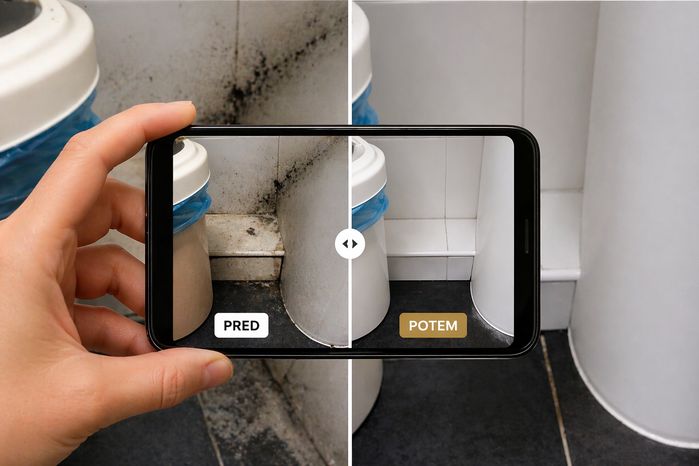
"Superautomatics that do milk drinks are a nightmare in an office setting; they're just nasty, despite best efforts."
r/superautomatic
"Mold and funky smell occasionally from the drip tray"
r/gaggiaclassic
"found pink biofilm slime in my machine"
r/espresso
"Biofilms are relatively impervious to bleaching, vinegar etc."
r/espresso
The end customer does not see the boiler. They see the drip tray, the waste bucket and the coffee. That is when they pick up the phone.
4Every day a machine is down costs someone money
"every day a machine is down means lost revenue."
r/FieldService
"I was out a machine for a week each time waiting for parts."
r/espresso
Technicians say they stock parts so they can charge "for one trip instead of two". r/espresso, technician AMA
Reference prices, US averages, for orientation only: heating element replacement on a commercial espresso machine $400 to $1,000; diagnostic service call $95 to $200; emergency or after-hours visit adds $150 to $400. Source: KitchenRepairHub.
The pattern
Put the 4 problems together and you get one cycle:
- Scale builds up in boilers and heating elements.
- An aggressive descaler removes it and can attack seals, plastics and aluminium on the way.
- Organic film comes back in drip trays, waste buckets and milk lines before the next scheduled visit.
- The end customer calls. The service company sends someone out, or replaces a part that could have been cleaned.
The chemistry is cheap. The visits and the parts are not.
What we do differently
No Stress is a professional cleaning line developed by a chemist with a pharmaceutical background. The rule behind it: clean the deposit, not the machine.
No Stone Professional: descaler for boilers and heating elements
- In a practical test, 2 heavily scaled heating sets were soaked for about 30 minutes, with no mechanical cleaning. One had already been replaced on site, the other was no longer considered worth cleaning.
- Scale, mineral deposits and most of the oxidation were removed. In this test, brass parts, plastics, silicone, rubber seals and electrical contacts showed no damage, and original labels and serial numbers stayed readable.
- Not a classic mineral acid. No neutralisation step. The working solution can be checked with a pH strip.
No Foul: against slime and biofilm between visits
- Field test at Kavomat servis, a coffee machine service company in Ljubljana: after cleaning, No Foul was sprayed on drip trays and collection areas. The treated condition held until the next scheduled service visit.
- About 4 sprays into the waste water bucket, and staff no longer noticed the smell.
- No hand irritation reported by service staff. Not a disinfectant: it does not replace a sanitising step where one is required.
No Grease: degreaser for coffee oils and organic dirt
- Tested on coffee machine buttons by a service company: dirt removed, no damage to paint or surface reported.
All 3 products, per their safety data sheets: not classified as hazardous under CLP (section 2.1), no special PPE needed in normal use (section 8.2), not dangerous goods for transport under ADR (section 14). Download the SDS and TDS.
Test it on your own machines
We do not ask you to take our word for it. Show us the problem on your equipment, your technicians run the test with us, and you judge the result.
- Pick 1 scaled boiler or heating element you were planning to replace.
- Pick 3 to 5 machines where the drip tray or waste bucket keeps coming back dirty.
- We send the product and the protocol. The samples are free.